When a B2B team asks us “should we run Meta Ads or stick with Google?” the honest answer is “it depends on what you sell, who you sell to, and how patient your CFO is.” Both channels can drive pipeline. Both can also incinerate budget. The decision is more nuanced than the over-confident takes on LinkedIn would suggest, and the right answer for a $5M-ARR self-serve SaaS is the wrong answer for a $50M-ARR enterprise platform.
This guide compares Google Ads and Meta Ads (Facebook + Instagram + Threads) for B2B teams in 2026 — cost, targeting precision, intent quality, attribution complexity, creative requirements, and the categories where each channel wins. We’ll also cover the hybrid model that works for most B2B teams, and the specific scenarios where one channel should completely dominate the other.
By the end you’ll have a clear decision framework — not a generic ‘it depends’ — for how to allocate budget between Google and Meta in your specific B2B context.
The fundamental difference: intent vs interest
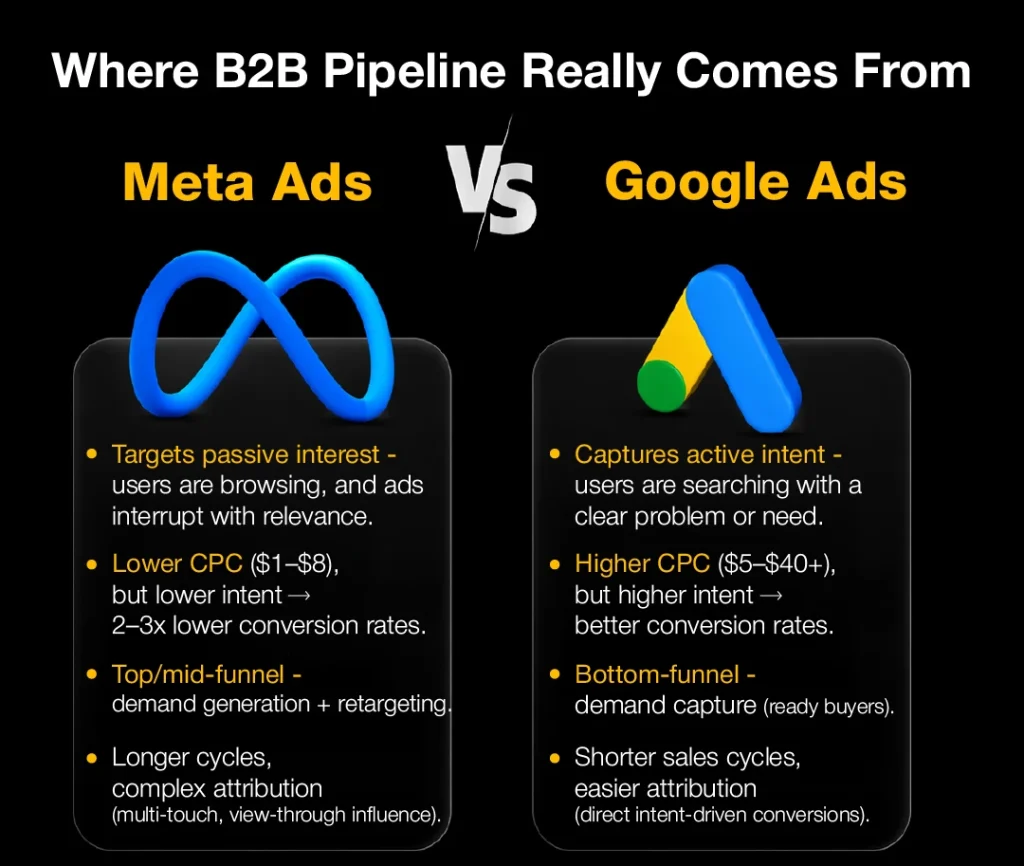
Google Ads — particularly search — sells against intent. The user has typed a query that signals they are actively looking for a solution. Meta Ads sells against interest. The user is scrolling, not searching, and you are interrupting them with something they might find relevant.
This single distinction explains 80% of the difference between the two channels. Intent-based ads convert faster but cost more per click. Interest-based ads convert slower but cost less per impression and reach buyers earlier in their journey — sometimes before they even know they have a problem.
If you only remember one thing from this comparison, remember this: Google harvests demand that already exists; Meta creates demand where it doesn’t yet. Both are valuable; they’re just doing different jobs in the funnel.
Cost comparison
B2B Google Ads CPCs range from $5 to $40+ for high-intent commercial keywords; B2B Meta Ads CPCs typically run $1-$8. So Meta is dramatically cheaper per click — but the click is also less qualified, and conversion rates are typically 2-3x lower on Meta for B2B funnels.
Net: CPLs are often comparable when measured properly. The real difference shows up in cycle length, lead quality, and the share of cold-to-warm conversions vs immediate-intent conversions. Meta leads typically take 1.5-3x longer to close than Google search leads, but they often have higher LTV because they’re drawn from a top-of-funnel population the brand introduced itself to.
Concrete numbers from recent B2B accounts
A B2B HR SaaS we audited recently spent $30k/month on Google ($165 CPL, 14-day average sales cycle) and $20k/month on Meta ($95 CPL, 38-day cycle). Same business, same offer, same landing pages — radically different channel dynamics. Both were profitable; cutting either would have hurt overall pipeline.
Targeting comparison
Google’s targeting is keyword-driven (intent-based) with audience layers (in-market, custom, remarketing) on top. Meta’s targeting is interest, behaviour, lookalike, and custom-audience based — virtually unlimited segmentation but no direct expression of intent.
For B2B, neither matches LinkedIn’s job-title and company-size precision. But Meta’s lookalike audiences off your closed-customer list can be surprisingly powerful for SMB-targeted B2B — especially when you feed it 1,000+ converted customers as the seed.
Creative requirements differ dramatically
Google Search creative is text — headlines, descriptions, sitelinks. Meta is video, image, carousel, and increasingly Reels-style short-form. The creative production demands are not comparable: a Google Ads program needs maybe 20 unique ads. A Meta program at scale needs 100+ creative variants per quarter, refreshed continuously.
Most B2B teams under-invest in Meta creative and then conclude the channel doesn’t work for them. The truth is the channel doesn’t work for their creative — and they never tested enough variants to find out.
When Google Ads wins for B2B
Google Ads is the right primary channel when: (a) buyers actively search for solutions in your category, (b) your average deal value justifies $200+ CPLs, and (c) you have a clean conversion path on your site. The vast majority of B2B SaaS, B2B services and B2B software fit this profile.
Brand search campaigns are almost always the highest-ROI campaign in any B2B account — they capture buyers who already know your name and would have converted anyway, but at a fraction of the cost of competitor terms. Always run brand campaigns even if budget is tight; they pay for themselves on day one.
- B2B SaaS with category awareness (HR, finance, marketing, sales tools).
- Professional services where buyers Google specific problems (legal, consulting, accounting).
- Replacement / migration plays (‘alternative to X,’ ‘X vs Y’).
- Local B2B services (manufacturers, distributors, regional consultants).
When Meta Ads wins for B2B
Meta wins for: (a) self-serve SaaS with consumer-style funnels (think Notion, Loom, Calendly tier products), (b) categories where buyers don’t actively search yet, (c) retargeting at scale where Meta’s audience-building is excellent, and (d) brand-building motions where you are trying to compress consideration cycles.
Meta also wins for many SMB-targeted B2B products where decision-makers behave more like consumers than enterprise buyers — small business owners scroll Instagram, not Gartner reports.
- Self-serve SaaS with sub-$200/mo plans and credit-card checkout.
- B2B products targeting solopreneurs, freelancers, agencies and SMBs.
- New-category products where buyer education matters more than intent capture.
- B2B brands that have invested in strong founder or thought-leader content.
The hybrid approach we recommend most
For most mid-market B2B teams, the answer is not either-or. Run Google search for intent capture, Google retargeting for warm-traffic conversion, and Meta retargeting plus a small Meta prospecting test for top-of-funnel demand generation. Measure each on its own role in the funnel — don’t compare CPL apples-to-oranges across them.
A typical mid-market split: 70% Google (60% search, 10% retargeting), 20% Meta (5% prospecting, 15% retargeting), 10% experimental. Adjust based on whether you’re more enterprise (push more to LinkedIn) or more SMB (push more to Meta).
Attribution: the elephant in the room
iOS privacy changes hit Meta harder than Google because Meta relies more on third-party signal. Even with the Conversions API and Advanced Matching properly implemented, Meta typically under-reports conversions by 15-30% in B2B contexts.
If you run Meta and judge it on platform-reported conversions only, you’ll systematically under-estimate its impact. Use a combination of platform data, GA4 cross-channel attribution, and self-reported attribution surveys to triangulate. Teams that do this consistently find Meta is contributing 30-60% more pipeline than the Meta dashboard suggests.
FAQs
