
There has never been more software available to a B2B sales team — and there has never been more risk of buying the wrong thing. The average mid-market sales org now uses between 10 and 16 sales tools, and Gartner’s 2024 buyer survey found that nearly half of those tools are underused or duplicated. The cost is not just licences; it is friction, context-switching and bad data flowing into the CRM.
This guide is the result of years of advising B2B teams on their sales stack — what to buy, what to consolidate, and how to sequence the build. We will walk through the seven categories of tools that actually move pipeline, the evaluation framework we use with clients, and a tool-by-tool breakdown linking to deep-dive reviews of every platform that genuinely matters in 2026.
We will cover sales engagement (Outreach, Salesloft, Apollo, Klenty, Reply.io), cold email (Lemlist, Instantly, Mailshake, Woodpecker), scheduling and meeting automation (Chili Piper), revenue intelligence (Gong, Clari), conversational marketing (Drift, Sendspark) and the data and orchestration layer (Apollo, ZoomInfo, 6sense). At the end, we will show you how to combine them into a stack that fits the size and motion of your team.
The 7 categories of a modern B2B sales stack
Every effective B2B sales stack we have seen, from 5-person startups to 500-person revenue orgs, can be mapped to seven categories. Not every team needs every category, and the order in which you adopt them matters enormously. Build them in the wrong order and your CRM becomes a graveyard of half-implemented tools.
The categories are: (1) sales engagement / outbound, (2) cold email, (3) scheduling and meeting automation, (4) revenue intelligence, (5) conversation intelligence, (6) conversational marketing, and (7) data and orchestration. Some categories overlap — Apollo, for example, is both data and engagement; Gong is both conversation and revenue intelligence — but the mental model holds.
How to evaluate a sales tool — build vs buy vs consolidate
The evaluation question that matters most is rarely “which tool is best?” — it is “do I need a new tool at all?” Before adding to the stack, run any candidate platform through three filters: does an existing tool already do this 80% as well, what is the all-in cost (licence + integration + training), and what specific revenue outcome will improve as a result?
If you cannot link the tool to a specific outcome — pipeline created, deals closed, win rate, cycle time — within 90 days, do not buy it. The graveyard of B2B sales tech is full of platforms that were great in demos and invisible in production.
- What specific revenue metric will this tool move, and by how much?
- Which existing tool’s licence will I cancel, downgrade or consolidate?
- Who in the team owns adoption — and how is success measured at 30, 60, 90 days?
- What is the integration cost — to CRM, calendar, dialer, and data warehouse?
- If we removed this tool in 6 months, what would break?
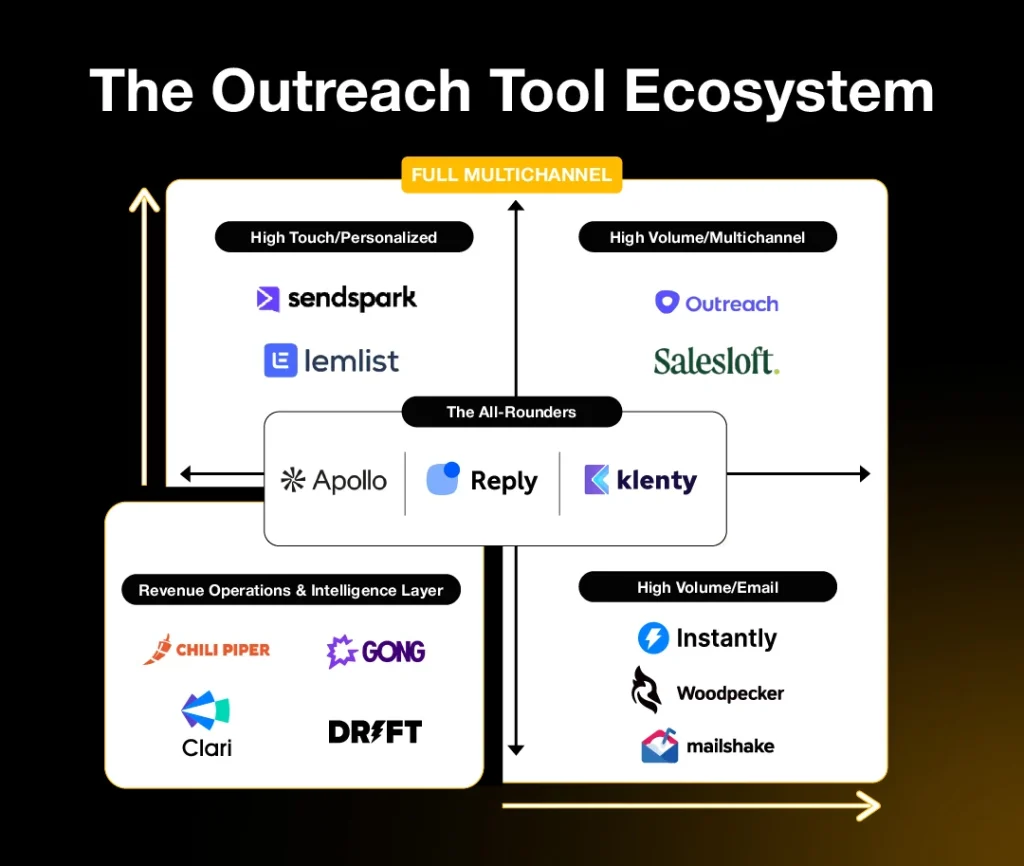
Sales engagement platforms
Sales engagement platforms — Outreach, Salesloft, Apollo, Klenty, Reply.io — are the operating system of an outbound sales team. They handle multi-touch sequencing, dialer integration, CRM sync, and increasingly AI-assisted message generation. For any team running outbound at scale, this is the foundational tool.
Outreach and Salesloft remain the enterprise standards. Apollo has aggressively moved upmarket with its all-in-one data + engagement model. Klenty and Reply.io serve mid-market teams well at lower price points.
Cold email platforms
Cold email is a category in transition. The 2024 Gmail and Outlook sender requirements destroyed bad senders, and the platforms that survived all invested heavily in deliverability infrastructure — inbox rotation, warm-up automation, automatic SPF/DKIM/DMARC validation. The 2026 winners are Lemlist, Instantly, Mailshake and Woodpecker, with Smartlead emerging strongly.
If you are running cold email seriously in 2026, the deliverability layer matters more than the sequencing layer. Pick a tool with a credible deliverability story first.
Scheduling and meeting automation
Chili Piper essentially defined this category and remains the leader. The right scheduling tool will route inbound demo requests to the correct owner instantly, qualify them on the form, and book the meeting before the buyer leaves the page. Speed-to-lead from 24 hours to 2 minutes is one of the highest-ROI changes any inbound team can make.
Revenue and conversation intelligence
Gong and Clari define this category. Gong records, transcribes and analyses every sales call to surface deal risk, coaching opportunities and competitive intelligence. Clari focuses on forecast accuracy and deal inspection. For sales teams above 8-10 reps, the ROI is clear: better coaching, more predictable forecasts, and a defensible answer to the CFO’s pipeline questions.
Conversational marketing
Drift, Sendspark and the broader conversational category turn high-intent website traffic into pipeline in real time. Drift’s chatbot routes high-value visitors to live conversations or scheduled meetings. Sendspark uses async video to make outreach more human. Both tools work best on websites with credible inbound volume — under 5,000 monthly visitors, the ROI is harder to defend.
Data and orchestration
Apollo, ZoomInfo, 6sense and Demandbase are the data and orchestration layer of a modern B2B revenue stack. Apollo and ZoomInfo are primarily contact-data platforms with growing engagement features. 6sense and Demandbase are intent and account orchestration platforms — they tell you which accounts are showing buying signals across the web, then help you act on those signals through ads, outbound and sales plays.
If you are running ABM seriously, this is the layer that compounds. Without intent data, ABM is a list and a set of templates. With intent, it becomes a real-time orchestration motion.
Building the right stack for your stage
For a 1-5 person sales team, start with a CRM, a single sales engagement tool (Apollo or Reply.io), a meeting scheduler (Chili Piper or Calendly) and one cold email tool (Instantly or Lemlist). That is enough for the first $1-2M in ARR.
For a 6-15 person team, add conversation intelligence (Gong or its lighter alternatives), a dedicated data provider (ZoomInfo or Apollo’s higher tier) and a more serious sales engagement platform (Outreach or Salesloft). This is where most teams over-buy and end up with overlapping licences.
For a 15+ person team running ABM, the data and orchestration layer becomes essential. 6sense or Demandbase, paired with a sales engagement platform and a revenue intelligence tool, is the modern enterprise default.
Tool-by-tool reviews
Sales engagement platforms
Outreach
Enterprise-grade sequencing, dialer and AI-assisted selling.
Best for: Mid-market and enterprise outbound teams.
Salesloft
Cadences, conversation intelligence and deal management in one suite.
Best for: Sales orgs prioritising coaching.
Apollo.io
All-in-one data + engagement platform.
Best for: Mid-market teams looking to consolidate.
Klenty
Multi-channel sequencing for SMB and mid-market.
Best for: Cost-conscious mid-market teams.
Reply.io
AI-driven sales engagement with strong cold email features.
Best for: AI-forward outbound teams.
Cold email platforms
Lemlist
Personalised cold email at scale with image and video personalisation.
Best for: Creative outbound campaigns.
Instantly
Inbox rotation and deliverability-first cold email.
Best for: High-volume outbound.
Mailshake
Reliable cold email and lead generation suite.
Best for: SMB sales teams.
Woodpecker
Deliverability-focused cold email with auto-warmup.
Best for: Agencies and lean outbound teams.
Scheduling, RevOps and conversational
Chili Piper
Instant inbound routing and meeting automation.
Best for: Inbound-heavy SaaS teams.
Gong
Conversation intelligence and revenue insight from every call.
Best for: Sales teams of 8+ reps.
Clari
Forecast accuracy and deal inspection.
Best for: Revenue and finance leaders.
Drift
Conversational marketing and live website chat for sales.
Best for: Inbound-heavy mid-market.
Sendspark
Async video for sales outreach and follow-up.
Best for: Reps differentiating with video.
Frequently asked questions
