
Performance marketing has become one of the most over-used and most misunderstood terms in modern marketing. For some teams it means “any paid ad we can measure.” For others, it means “only the channels where we pay per click or per lead.” For still others particularly in B2B it has come to mean a discipline, a way of operating, and a framework for connecting every marketing dollar to a tangible business outcome.
In 2026, the line between performance and brand has blurred even further. Performance Max, Advantage+, AI-driven creative testing and server-side conversion modelling have all reshaped what “measurable” actually means. At the same time, B2B buying journeys have lengthened the average enterprise SaaS deal now touches 11+ marketing surfaces before a sales conversation, according to recent Forrester data making single-touch attribution feel almost quaint.
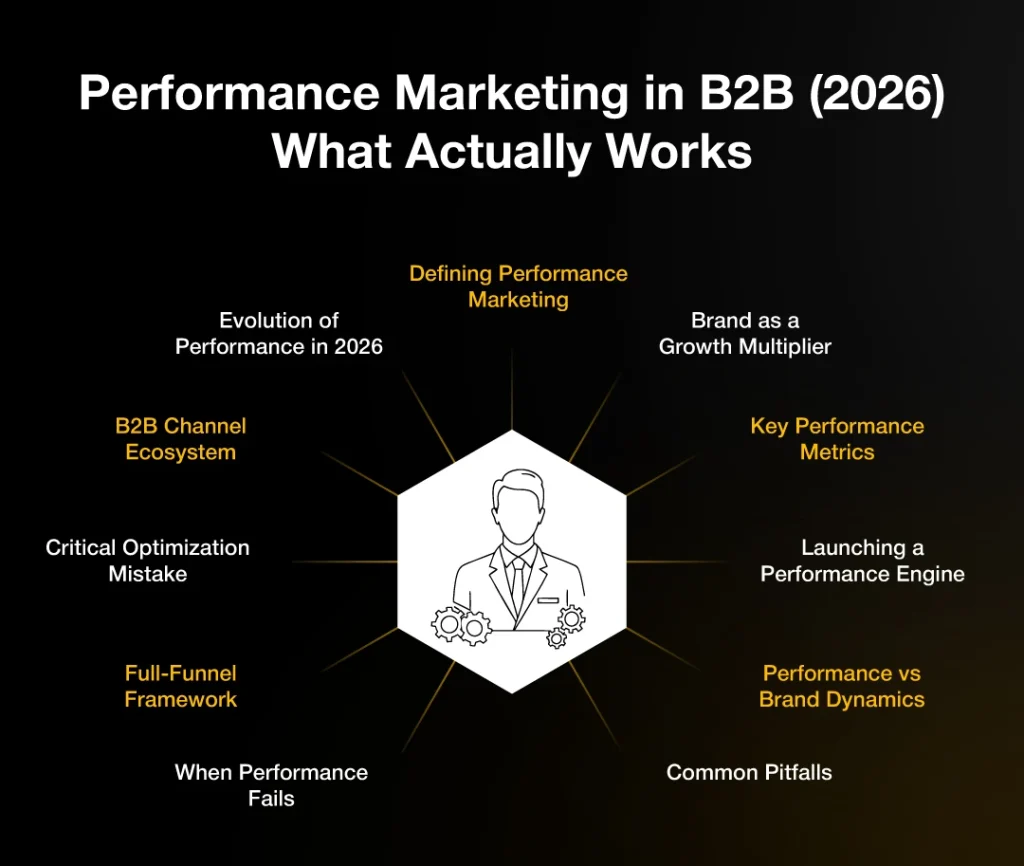
This guide unpacks what performance marketing actually means in a B2B context in 2026, the channels and metrics that matter, the frameworks that separate sophisticated programs from amateur ones, the most common failure patterns we see, and how performance marketing differs from (and ultimately compounds with) brand marketing. It’s written for in-house B2B marketers, founders, and growth leaders who want a complete mental model not just a glossary entry.
Defining performance marketing in 2026
At its simplest, performance marketing is paid media activity where every dollar of spend is tied to a measurable outcome a click, a lead, a meeting booked, an opportunity created, or revenue closed. The defining property is measurability and accountability, not the channel itself. A YouTube video can be brand marketing or performance marketing depending on whether you’re optimising for view-through reach or qualified demo requests.
In B2B, the most common performance channels are Google Ads, Microsoft Ads, LinkedIn Ads, Meta Ads (more on that later), retargeting, programmatic display, paid newsletter sponsorships, and increasingly Reddit, Quora and YouTube. The unifying thread is that each impression, click and conversion can be tracked back to a campaign, an ad and a creative and ultimately to revenue.
What separates 2026 performance marketing from the 2018-era version is the addition of three layers: first-party data activation (because cookies are largely dead), AI-assisted creative iteration (because manual creative testing can’t keep up), and full-funnel attribution that includes view-through, dark social, and self-reported attribution from forms. If your definition of performance marketing stops at “last-click conversions in Google Ads,” you’re working with a 2015 model.
How performance marketing differs from brand marketing
Brand marketing builds long-term equity awareness, perception, trust and is typically measured in soft metrics (brand search volume, share of voice, sentiment, prompted recall). Performance marketing builds short-term outcomes leads, demos, pipeline and is measured in hard metrics (CPL, CPA, ROAS, CAC payback).
The mistake B2B teams make is treating these as opposing disciplines competing for the same budget. The truth is they compound. Brand marketing reduces the cost of performance marketing by raising baseline awareness every percentage point of brand recall reduces your CPC and lifts your conversion rate. Performance marketing creates the funnel events that prove brand investment is working. The best B2B programs run both in parallel and explicitly measure how each affects the other.
The simplest test: if you turn off your brand campaigns for two weeks, does your performance CPL stay flat? If yes, your brand isn’t doing its job. If no, you’ve just measured the leverage brand provides to performance and you should be funding it accordingly.
Brand-as-multiplier framework
We model brand investment as a multiplier on every downstream performance dollar. A B2B company with strong brand recognition typically sees 30-60% lower CPLs, 20-40% higher conversion rates, and 15-25% faster sales cycles than category peers with weaker brands. That multiplier is the real ROI of brand investment it doesn’t show up in a Google Ads dashboard, but it shows up in CAC payback.
The full performance channel landscape
There is no universal “best channel” for B2B performance marketing. Channel selection depends on your ICP, your buying cycle length, your unit economics, and where your buyers actually spend time. Below is the complete channel taxonomy we use when building B2B performance programs.
- Google Search Ads — highest-intent channel; pay-per-click against active queries.
- Google Display & YouTube — broader reach; useful for retargeting and brand-adjacent demand gen.
- Microsoft Ads (Bing) — under-utilised in B2B; older, higher-income buyers; lower CPCs than Google.
- LinkedIn Ads — most precise B2B targeting; expensive but unmatched for ICP-based campaigns.
- Meta Ads (Facebook + Instagram) — interest-based; works for SMB B2B and self-serve SaaS.
- Reddit Ads — increasingly used for technical B2B (DevOps, data, security).
- Quora Ads — high intent for problem-aware buyers; underrated for SaaS.
- Programmatic display & native (Outbrain, Taboola) — scale-driven; rarely highest ROI but useful for retargeting.
- Paid newsletter sponsorships (Beehiiv, Substack, industry-specific) — high trust, narrow reach.
- G2 / Capterra / TrustRadius paid placements — bottom-funnel intent for SaaS.
The core metrics that matter
Across B2B performance programs, six metrics matter most: Cost Per Click (CPC), Click-Through Rate (CTR), Cost Per Lead (CPL), Cost Per Acquisition (CPA), Return On Ad Spend (ROAS), and Customer Acquisition Cost (CAC). Conversion Rate cuts across all of them, and CAC payback period is the executive-level summary metric.
The trap most teams fall into: optimising for the easiest metric to move (usually CPL) at the expense of the hardest (CAC payback and lifetime ROAS). A program that drives down CPL while CAC quietly rises is a program that is making the marketing dashboard look good and the P&L look bad. We’ve seen accounts cut CPL by 40% while pipeline value dropped 60% because the leads that remained were lower-quality form-fillers from broad-match keywords.
The discipline is to build dashboards that connect every funnel-entry metric to a downstream pipeline metric, and to refuse to celebrate movement in the former unless the latter follows.
The 4-stage performance marketing framework we use
We run every B2B performance program through a four-stage framework: (1) intent capture, (2) demand generation, (3) retargeting, (4) measurement and attribution. Each stage uses different channels, has different success metrics, and demands different creative formats. Conflating them running everything as if it’s intent capture is the most common reason performance programs underperform.
- Intent capture: Google Ads (search), Microsoft Ads, branded campaigns, G2/Capterra. Measured on CPL and pipeline created.
- Demand generation: LinkedIn Ads, YouTube, programmatic display, podcast sponsorships. Measured on assisted conversions, branded search lift, and direct-traffic lift.
- Retargeting: Google retargeting, LinkedIn retargeting, Meta retargeting, custom audiences. Measured on conversion rate uplift and cost-per-acquisition for warm traffic.
- Measurement and attribution: GA4, server-side tracking, multi-touch attribution, self-reported attribution surveys. Measured on attribution clarity and forecast accuracy.
Real B2B examples: how the framework plays out
To make this concrete, here are three composite examples drawn from B2B programs we’ve run:
Example 1 — Mid-market HR SaaS ($15M ARR)
Spend: $80k/month. 60% Google Search (intent capture against “hr software,” competitor terms, and high-intent long-tail). 25% LinkedIn (demand generation against HR Directors at 200-2000 employee companies). 10% retargeting across Google + LinkedIn. 5% experimental (Reddit and podcast sponsorships).
Outcome at 90 days: CPL $180 on Google, $340 on LinkedIn. Pipeline-to-CAC ratio of 4.2x. The LinkedIn channel had double the CPL but produced deals with 60% higher ACV a fact that only showed up because the team was tracking pipeline value, not just lead volume.
Example 2 — Enterprise cybersecurity ($60M ARR)
Spend: $250k/month. Heavy focus on ABM-style LinkedIn (40%), G2 + Gartner (20%), Google Search for problem-aware queries (25%), retargeting (15%).
Outcome: Almost no leads attributable to a single channel. The team switched to multi-touch attribution and self-reported sourcing, and discovered LinkedIn was first-touching 70% of closed deals despite getting last-click credit on only 15%. They tripled LinkedIn budget and saw pipeline grow 50% within two quarters.
Example 3 — Self-serve developer tool ($3M ARR)
Spend: $25k/month. 50% Reddit and Hacker News-adjacent placements, 30% Google Search on “open source alternative to X” queries, 20% retargeting on Twitter/X and Reddit.
Outcome: $42 CPL on Reddit, $90 on Google Search. Reddit ads worked because the audience was technically credible and the creative was treated as content, not as advertising a critical pattern for developer-led SaaS.
Common failure patterns
Across hundreds of B2B account audits, the same five failure patterns repeat:
- Treating every channel as if it should perform like Google Search measuring LinkedIn or YouTube on last-click CPL guarantees you cut budget on channels that are working further up the funnel.
- Optimising for form fills instead of qualified pipeline your smart bidding will then optimise for the cheapest form-fillers, which are usually the lowest quality.
- Running performance with broken conversion tracking half the B2B accounts we audit have at least one major tracking gap (missing offline imports, tag fire failures, or duplicate counting).
- Underinvesting in creative most programs spend 95% on media and 5% on creative, then wonder why CTR plateaus. Creative is the highest-leverage variable in 2026.
- Confusing brand and performance budgets and then resenting brand when performance numbers wobble, even though brand is the multiplier making performance work.
When performance marketing is the wrong answer
Performance marketing is not always the right tool. If you are pre-product-market-fit, your unit economics are unproven, or you are trying to enter a category where buyers don’t search for solutions yet, performance marketing will burn budget. In those cases, content marketing, founder-led sales and brand investment will produce more durable outcomes.
The cleanest indicator that performance is right for you: there is provable buying intent for what you sell (people are searching for it on Google or asking for it on LinkedIn), AND you have a measurable conversion path on your website that converts at a healthy rate (3%+ for B2B landing pages). Without both, performance is premature and you should fix the conversion path first.
The second-cleanest indicator: your sales team can name the keywords your customers used to find you. If they can, performance has a foundation to build on. If they can’t, you’re earlier in your category’s life-cycle than your spend pattern suggests.
How to start a performance marketing program from zero
If you’re starting from scratch, here is the order of operations we use when standing up a B2B performance program:
- Week 1-2: Audit conversion tracking, install GA4 + Google Tag Manager + server-side tagging. Define primary conversion (usually demo request) and secondary conversions.
- Week 2-3: Build branded search campaign first (cheapest, highest ROAS, fast learnings).
- Week 3-5: Layer high-intent commercial keywords (‘X software,’ ‘X tool,’ competitor terms).
- Week 5-8: Add LinkedIn for top-of-funnel ICP targeting (lead-gen forms first, then content-led conversation ads).
- Week 8-12: Layer retargeting across Google and LinkedIn. Begin offline conversion imports from CRM.
- Week 12+: Test demand-gen channels (YouTube, Reddit, podcast sponsorships) once attribution can prove their incremental contribution.
FAQs
