Why this category matters
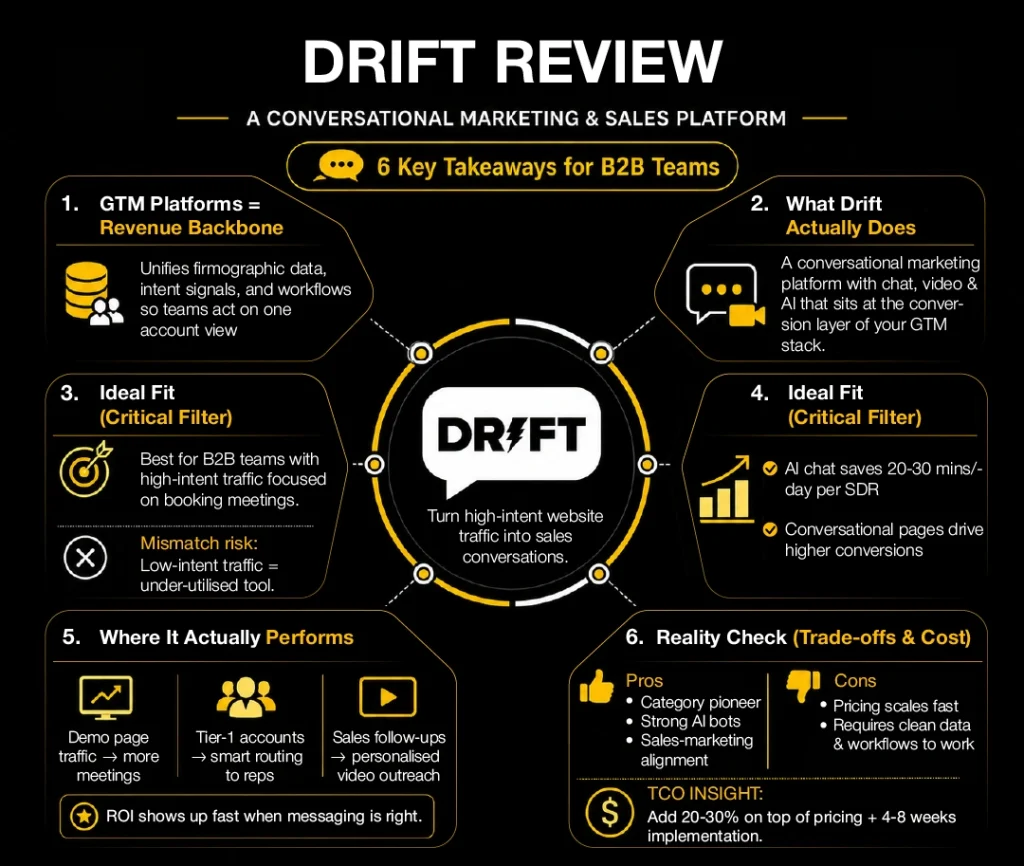
GTM platforms are the connective tissue of a modern B2B revenue stack. They unify firmographic data, intent signals, account scoring and orchestration so that marketing, sales and customer success can act on the same view of an account. The category has matured rapidly, and the question for most teams is no longer whether to invest, but which platform fits the size of the motion you are trying to run.
Drift Review is one of the more talked-about tools in this space. In this review we look at what it actually does, who it is genuinely a fit for, where the trade-offs sit, and how it compares to the alternatives most B2B teams evaluate alongside it.
This guide is written from the perspective of an operator. We have worked with B2B teams across SaaS, services and enterprise running these tools at scale, and the framework below is the same one we use internally before recommending a platform to a client at bratz digital.
What Drift Review actually is
A conversational marketing platform with chat, video and AI for B2B websites. That is the marketing line, but the more useful framing is this: Drift Review sits in the part of a B2B revenue stack where you unify firmographic data, intent signal and account workflow so revenue teams act on the same view of the buyer.
For teams that match its sweet spot — b2b marketing teams that want to convert high-intent website traffic into sales conversations. — it earns its place quickly. For teams that do not, it usually shows up as either an under-utilised line item or a frustrating mismatch with how the team actually operates.
Best fit
B2B marketing teams that want to convert high-intent website traffic into sales conversations.
Feature deep-dive
Marketing pages tend to list features as bullet points. The more useful question is what each feature unlocks in practice. Here is how the core Drift Review capabilities translate into operational reality:
Live chat + AI chatbots
In day-to-day use this is one of the features SDRs notice first. It removes a manual step that would otherwise eat 20-30 minutes a day per rep.
Conversational landing pages
This is where Drift Review earns its keep against cheaper alternatives. Done well, it is the difference between a campaign that books meetings and one that gets ignored.
Video for sales (Drift Video)
The depth here matters more than the surface description. Compare implementations carefully — two tools can claim the same capability and deliver very different results.
Account-based playbooks
Often overlooked at evaluation time, this becomes important once volume increases. We recommend testing it explicitly during the trial.
Deep CRM integrations
This is table-stakes for the category in 2026. Make sure the implementation is bi-directional and well-documented before you commit.
Where it shines: real-world use cases
Tools rarely fail because of missing features. They fail because they are deployed against the wrong use case. The use cases below are the ones where Drift Review consistently delivers value:
Converting demo-page traffic into meetings
Teams running this play with Drift Review typically see the biggest impact in the first 60 days when message-market fit is dialled in. The tool is the lever; the messaging is still the work.
Tier-1 account routing to specific reps
Teams running this play with Drift Review typically see the biggest impact in the first 60 days when message-market fit is dialled in. The tool is the lever; the messaging is still the work.
Sales-led video follow-up
Teams running this play with Drift Review typically see the biggest impact in the first 60 days when message-market fit is dialled in. The tool is the lever; the messaging is still the work.
How to evaluate it against alternatives
When B2B teams shortlist Drift Review, they usually evaluate it alongside Chili, Salesboxai, 6sense and Sendspark. The right way to compare is not feature-for-feature but to score each option against the criteria that actually matter for your motion. We use this checklist:
- Data depth and recency in your target geography
- Intent data signal quality (third-party providers vs first-party)
- Native CRM and marketing automation integration
- Workflow engine flexibility for routing and enrichment
- Predictive scoring transparency
- Total cost including implementation and managed services
Our recommendation
Score each shortlisted tool from 1-5 against the criteria above, weighted by what matters to your team. The winner on the spreadsheet is rarely the most-hyped option — it is the one that fits how you actually run revenue.
Implementation: the first 30 days
Buying a tool is the easy part. The teams that get value from Drift Review (or any tool in this category) follow a consistent rollout pattern. Here is the sequence we recommend in the first 30 days:
Define ICP and tiering in writing
Before you turn the platform on, agree on what counts as a tier-1, tier-2 and tier-3 account. Get marketing, sales and RevOps to sign off. The platform will enforce this tiering across every workflow downstream.
Connect the data pipes
CRM sync, marketing automation, ad platforms and your data warehouse. The platform’s account view is only as accurate as the data you feed it. Plan a 4-6 week implementation just for clean data flow.
Choose 3-5 plays, not 30
Most teams under-perform with these platforms because they try to launch every play in the playbook. Pick a small number of high-value plays — for example, intent-spike outbound, post-demo nurture, dormant pipeline reactivation — and run them well.
Train the field
Sales reps need to know what the new account scores mean and how to use the intelligence in their daily workflow. Plan formal enablement, not just an email.
Review monthly, not quarterly
Account scores drift. Intent topics need refining. New plays surface. Treat the platform as a living system that needs a monthly RevOps review to stay valuable.
Pros and cons in plain language
Every tool involves trade-offs. The most useful pros and cons are the ones written from the perspective of a team that has actually run the platform for six months, not from a launch-day blog post.
✓ Pioneered the category
This shows up consistently in operator reviews and matches our experience deploying the tool with B2B clients.
✓ Strong AI bots
This shows up consistently in operator reviews and matches our experience deploying the tool with B2B clients.
✓ Solid sales-marketing alignment
This shows up consistently in operator reviews and matches our experience deploying the tool with B2B clients.
× Pricing climbs fast
Worth weighing carefully — this is the kind of constraint that becomes painful at month six, not month one.
× Now part of Salesloft — roadmap consolidating
Worth weighing carefully — this is the kind of constraint that becomes painful at month six, not month one.
Pricing and total cost of ownership
Public pricing for Drift Review starts at Custom enterprise pricing. The headline number is rarely the real cost. Add the implementation effort, the data add-ons, the managed-service layer if you need it, and the opportunity cost of the rollout itself.
For a realistic total-cost-of-ownership view, multiply the per-seat price by your team size, add 20-30% for add-ons, and budget 4-8 weeks of internal time for implementation. That number is what should go into your business case.
Verdict
Drift Review is a solid pick if your motion looks like the “best for” profile. It is not the right pick if you need a tool to do everything — almost no platform in this category is. The category leaders, including Drift Review, now do the core job well; the differentiation is at the edges.
A GTM platform is only as good as the data you feed it and the workflows you commit to. The teams that get value here are the ones who treat the platform as the source of truth for ICP, intent and orchestration — not as another dashboard to log into.
If you want help designing the right GTM stack and the campaigns that run on top of it, that is what we do at bratz digital. Explore our work in B2B SEO, performance ads, ABM and outreach — or read the full category pillar for the side-by-side comparison.
Frequently asked questions
Is Drift Review worth it in 2026?
If your team matches the “best for” profile (b2b marketing teams that want to convert high-intent website traffic into sales conversations.), yes — Drift Review is worth a serious evaluation. The category has consolidated and the leaders, including Drift Review, now offer enough depth to run a real motion. The question is fit, not quality.
What does Drift Review integrate with?
Most modern revenue tools integrate with the major CRMs (Salesforce, HubSpot, Pipedrive), the major calendar systems and Zapier or webhooks for everything else. Drift Review follows the same pattern. Before you commit, confirm the depth of the CRM sync — bi-directional vs one-way matters more than logo coverage.
Can Drift Review replace our current stack?
Rarely. Most B2B teams end up with a stack of 3-5 specialised tools rather than one monolith. Drift Review typically replaces 1-2 adjacent tools, not the whole stack. Map your current motion first, identify the most expensive seam, and let that drive the consolidation decision.
