
LinkedIn Ads and Google Ads are the two pillars of most B2B performance programs in 2026 but they solve fundamentally different problems. Google captures expressed intent; LinkedIn precisely targets the people who matter regardless of whether they’re searching today. The teams that misallocate between them either pay too much for too few leads or generate volumes of leads that never convert.
This guide is a side-by-side comparison built from years of running both channels in parallel for B2B clients across SaaS, services, and enterprise software. We’ll cover cost, targeting, intent quality, attribution complexity, creative requirements, common failure modes, and how to allocate budget between them based on your specific motion (PLG, sales-led, ABM, or hybrid).
By the end you’ll know exactly what each channel should be doing in your program and how to measure its true contribution not just last-click form fills.
Cost comparison
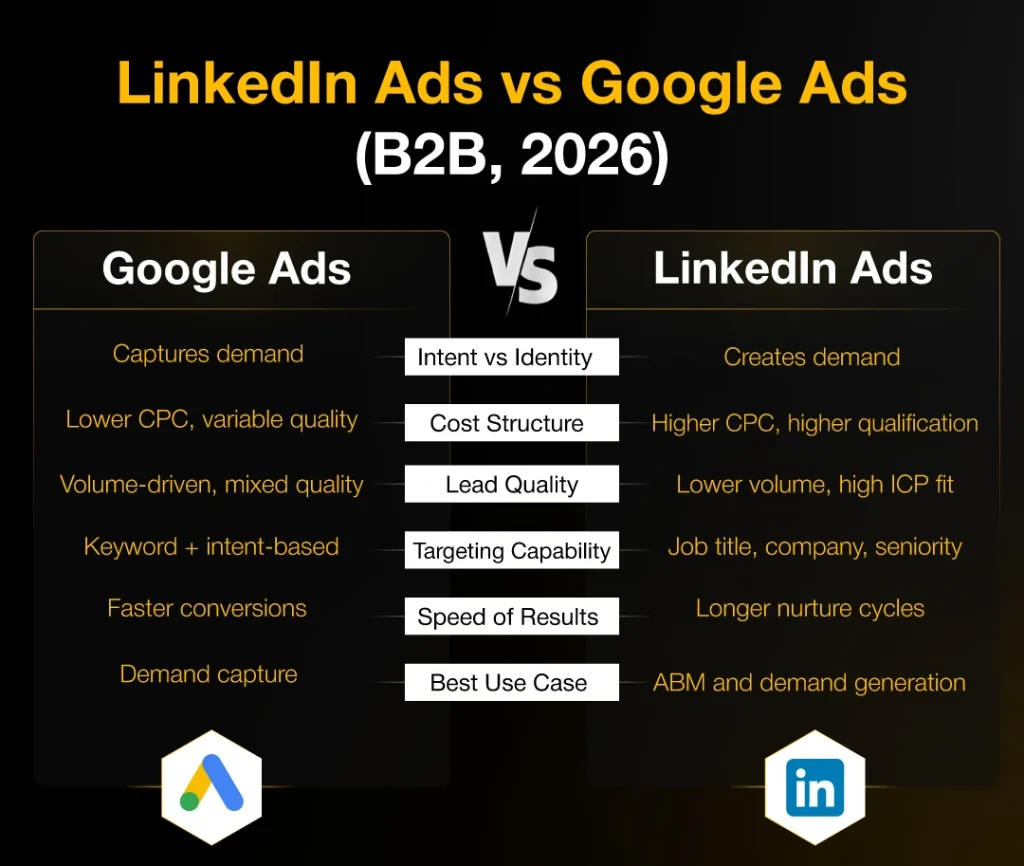
LinkedIn Ads is the most expensive channel in B2B per click $8-$25 CPC is typical, with high-competition categories pushing past $40. Google Ads is cheaper per click but more variable: $3-$15 for most B2B categories, $40+ for legal and finance.
What matters is not CPC but CPL and CAC. LinkedIn often produces lower-volume but higher-quality leads, especially for ABM motions. Google typically produces higher-volume leads with more variability in quality. The right comparison isn’t ‘which has lower CPL’ but ‘which has lower fully-loaded CAC for the kinds of customers we want.’
The hidden cost of cheap clicks
Cheap clicks from broad-match Google or untargeted Meta often produce leads your sales team rejects. The fully-loaded cost of an unqualified lead is much higher than its CPL sales time wasted, CRM clutter, and demoralised reps all compound. LinkedIn’s higher CPC is partly buying you sales-team efficiency.
Targeting comparison
LinkedIn wins on B2B targeting precision job title, function, seniority, company size, industry, member skills, and even named-account targeting are all native. Nothing else in performance marketing comes close. You can build an audience of “VPs of Marketing at SaaS companies between 200 and 2,000 employees in the US who follow at least one of our competitor’s pages” in under a minute.
Google wins on targeting through expressed intent keywords reveal active buyer behaviour. Audience targeting on Google is improving rapidly (with custom segments and in-market audiences) but doesn’t approach LinkedIn’s precision for B2B persona work.
The combination is powerful: LinkedIn for precision against the right people, Google for capturing the moments those same people are actively searching.
Intent quality
Google search ads target buyers who are actively researching. LinkedIn Ads target the right people regardless of where they are in their journey. The result: Google produces faster pipeline, LinkedIn produces longer cycles but better account fit.
For long-cycle enterprise B2B (ACVs above $50k, sales cycles above 90 days), LinkedIn often wins on lifetime value despite slower conversion. For short-cycle mid-market or SMB B2B (sub-$20k ACV, 30-day cycles), Google usually wins on payback period.
Creative and format differences
Google Search is text-only. LinkedIn supports single-image, video, carousel, document, conversation, message, lead-gen forms, and event ads. Each LinkedIn format has different best practices carousel ads consistently outperform single-image for content distribution, document ads excel at thought leadership, conversation ads work for high-touch ABM.
Most B2B teams under-test LinkedIn formats and over-rely on single-image. The fastest LinkedIn improvement most teams can make is testing document ads and conversation ads against their current single-image baseline.
How to allocate budget
Our default allocation for a mid-market B2B program: 60% Google (split across search and retargeting), 30% LinkedIn (split across content and lead-gen forms), 10% experimental (Meta retargeting, YouTube, Reddit). Adjust based on your motion:
- PLG / self-serve SaaS: 70% Google, 15% LinkedIn, 15% Meta.
- Sales-led mid-market: 60% Google, 30% LinkedIn, 10% experimental.
- Enterprise / ABM: 35% Google, 55% LinkedIn, 10% direct ABM platforms (6sense, Demandbase).
- Pure brand-build motion: 25% Google brand, 50% LinkedIn thought leadership, 25% Meta + YouTube.
Attribution challenges
LinkedIn rarely gets last-click credit because buyers tend to search after seeing LinkedIn ads. If you are last-click attribution, you will systematically under-credit LinkedIn and over-cut its budget. Use multi-touch attribution or at minimum view-through reporting to get a fair picture.
Add a self-reported attribution field to your demo request form (“How did you first hear about us?”). This single field consistently surfaces LinkedIn’s true contribution at 2-3x what last-click attribution suggests.
Server-side tracking via the LinkedIn Conversions API also helps it captures conversions that client-side pixels miss because of ad blockers and browser privacy settings.
Common failure modes
Failure modes specific to each channel:
- Google: Broad match without negative-keyword discipline, leading to wasted spend on irrelevant queries.
- Google: Optimising bid strategy on form fills instead of qualified leads.
- Google: No brand campaign competitors bid on your name and steal warm traffic.
- LinkedIn: Audience too broad (over 500k members), leading to wasted budget on non-ICP impressions.
- LinkedIn: Single-image-only creative, no format testing.
- LinkedIn: Judging the channel on last-click CPL within 30 days.
When to pause one of the two
Pause Google if your category genuinely has no search demand (very rare in 2026). Pause LinkedIn if your target buyer doesn’t use LinkedIn (common for blue-collar, manufacturing-floor, or government buyers). Otherwise, both channels almost always belong in a mature B2B program the question is the ratio, not the presence.
FAQs
