
Retargeting is one of the highest-ROI activities a B2B team can run — when it is built thoughtfully. It is also one of the most commonly fumbled. The most common mistakes: too-broad audiences, the same creative shown to everyone, no frequency cap, no honest measurement of incremental impact, and no exit criteria for when to stop chasing a non-converter.
Done well, retargeting compresses sales cycles, lifts conversion rates on every other channel, and produces some of the lowest CPAs in your account. Done badly, it creates brand fatigue, inflates last-click metrics with conversions that would have happened anyway, and burns budget on clicks from people who left your site for a reason.
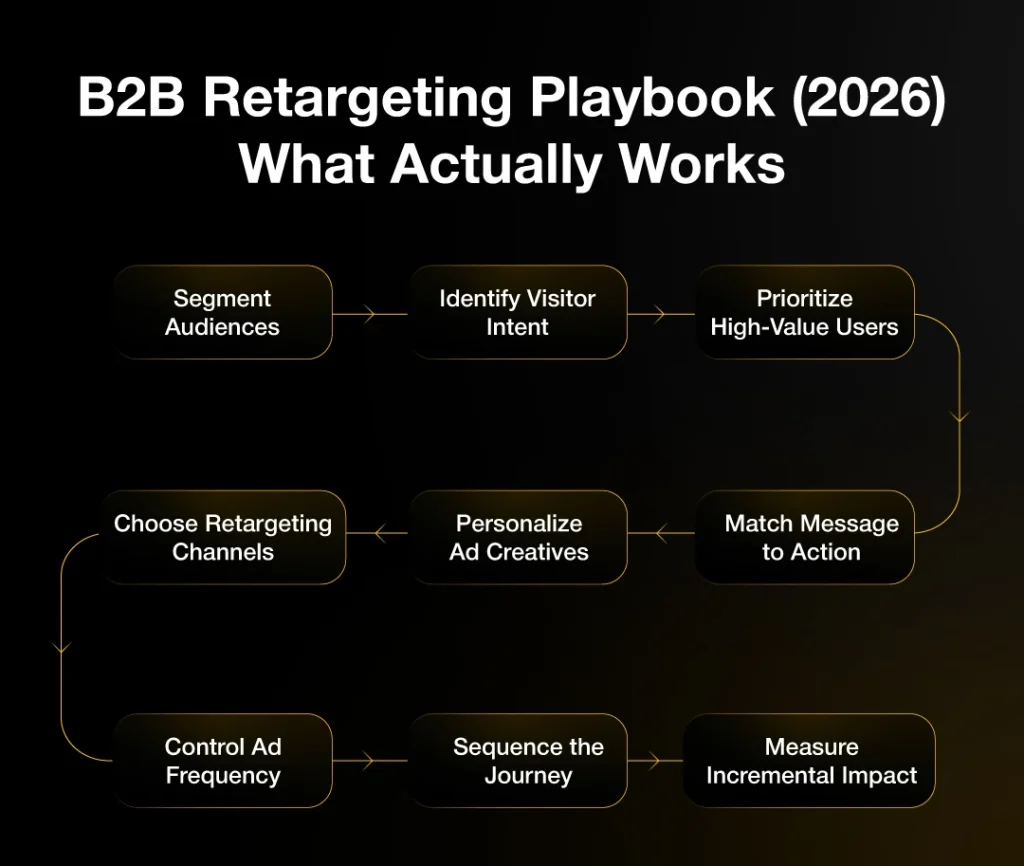
This guide is a complete retargeting playbook for B2B teams in 2026 — audience strategy, channel mix, creative principles, frequency rules, sequencing, and how to actually measure whether your retargeting is creating new conversions or just claiming credit for ones that would have happened anyway. By the end you’ll have a clear plan for building (or rebuilding) a retargeting program that’s genuinely incremental.
Audience strategy: segment ruthlessly
The single biggest retargeting upgrade most B2B teams can make is segmenting audiences by behaviour. Build separate audiences for: (a) all visitors (excluded — too broad), (b) blog/content readers, (c) pricing page visitors, (d) demo/contact page visitors, (e) form abandoners, (f) existing customers (excluded), (g) competitor-comparison page readers, (h) free-trial signups who didn’t convert.
Each segment gets different creative and a different ask. A pricing-page visitor sees a demo CTA. A blog reader sees a content asset. A form abandoner sees a friction-reducing message (“Still thinking? Let us answer questions over email instead.”). The granularity matters — generic retargeting is a generic experience, and generic experiences don’t convert in B2B.
Channel mix
For B2B, retargeting works best on Google (display + search RLSA), LinkedIn, Meta, and YouTube. Programmatic display is acceptable for scale but rarely the highest-ROI channel for B2B. Native ad networks (Outbrain, Taboola) work for content-led retargeting but rarely for direct-response.
LinkedIn retargeting is the most expensive but highest-quality. Use it for high-value segments (pricing, demo, ICP-fit) and use Google/Meta for broader content readers. Mixing channels lets you reach the same buyer in multiple contexts, which compounds recall.
Creative principles
Retargeting creative must (a) reference the visitor’s action (“Saw our pricing page?”), (b) reduce friction to next step, and (c) include social proof. Same-creative-to-everyone retargeting is a waste of budget.
Rotate creative every 2-3 weeks to avoid fatigue. Track ad-level CTR and replace under-performers. Build a backlog of 20-30 creative variants per audience segment — you’ll burn through them faster than you expect, especially on high-frequency segments.
Format matters: short-form video (15-30 seconds) consistently outperforms static images for B2B retargeting on Meta and YouTube. On LinkedIn, document and carousel ads outperform single-image. On Google Display, animated HTML5 outperforms static image.
Frequency caps
For B2B, cap impressions at 3-5 per day per user, 25-35 per week. Above that, you’re producing diminishing returns and brand resentment. Aggressive retargeting programs that ignore frequency caps lift unsubscribes and brand damage at the same rate as conversions.
Set hard exit criteria — after 60 days of no conversion, suppress the user from your retargeting pool. They’re not converting. Continuing to spend on them is throwing money away while annoying a potential future buyer.
Sequencing: tell a story over time
Sophisticated retargeting tells a story across exposures rather than repeating one message. A typical B2B sequence: ad 1 reinforces what the visitor saw on your site → ad 2 introduces social proof (case study, customer logo) → ad 3 reduces friction (free trial, no-credit-card-required) → ad 4 creates urgency (limited-time offer or new feature).
Sequencing requires planning the journey, building the creative backlog upfront, and using audience-exclusion logic to ensure each user sees the sequence in order. Most teams skip this work; the ones who do it consistently outperform.
How to measure incremental impact
Run holdout tests — randomly exclude 5-10% of your retargeting audience and compare conversion rates between exposed and unexposed groups. This gives you true incremental lift, not last-click credit.
Most B2B teams discover their retargeting is 30-50% less impactful than last-click attribution suggests once they run holdout tests. That’s not a reason to stop retargeting — it’s a reason to scale only what’s actually incremental, kill the segments that aren’t, and reallocate budget toward the highest-lift segments.
Run holdout tests quarterly at minimum. Channels and creative both decay; what was incremental six months ago may not be today.
B2B-specific patterns to copy
Patterns that consistently work for B2B retargeting:
- Pricing-page retargeting with a ‘speak to sales’ offer (highest-converting B2B retargeting segment, almost universally).
- Competitor-comparison retargeting with a head-to-head doc or migration offer.
- Free-trial-no-conversion retargeting with feature-education sequences.
- Webinar-attendee retargeting with on-demand recording + book-a-call offer.
- Content-reader retargeting with a sequel asset, then a related case study, then a demo offer.
- Existing-customer retargeting with upsell or new-feature messaging (kept separate from acquisition).
Common pitfalls to avoid
The patterns we see fail most often:
- One creative for all audiences — wastes budget and produces brand fatigue.
- No frequency cap — converts retargeting into harassment.
- 180-day retargeting windows for content readers — paying for unlikely conversions.
- Including existing customers in retargeting pools — confusing brand experience and wasted spend.
- Judging retargeting on last-click conversion rates — flatters the channel without proving incrementality.
FAQs
