Most B2B Google Ads accounts we audit have the same five problems: undisciplined keyword match types, broken or partial conversion tracking, weak landing pages, no negative-keyword discipline, and a campaign structure that makes optimisation almost impossible. Solving any one of them improves account performance; solving all five typically transforms it.
This guide is the complete strategy framework we use when we rebuild B2B Google Ads accounts from scratch — how to structure the account, choose match types, write ads, build landing pages, set bid strategies, and report on what’s actually moving pipeline. It’s written for marketers who already understand the basics of Google Ads and want a senior practitioner’s playbook for getting more out of every dollar.
We’ll cover the strategic frame first, then the tactical execution, then the reporting layer that ties it all back to revenue.
Account structure: separate intent from theme
Structure campaigns by intent first, then by theme. Brand campaigns get their own campaign. High-intent commercial keywords (“X software,” “X tool,” “buy X”) get their own. Educational keywords (“how to,” “what is”) get their own. Competitor terms get their own.
This structure lets you set bid strategies independently — you don’t want the same target CPA for brand search ($20) as for cold competitor terms ($300). It also lets you allocate budget by intent stage, ringfence brand spend (which is always your highest-ROAS line), and report cleanly on which intent layer is producing what.
A standard B2B account structure looks like: [Brand], [Competitor], [Commercial-High-Intent], [Commercial-Mid-Intent], [Educational], [Retargeting Display], [YouTube]. Each campaign gets a clear conversion goal, a clear bid strategy, and a clear budget envelope.
Keyword strategy: phrase and exact, with disciplined broad
For B2B, default to phrase and exact match. Broad match has improved significantly since 2023 with Google’s smart bidding, but it still requires aggressive negative keyword management to avoid spend on irrelevant terms — and most B2B teams don’t have the discipline to manage broad-match well.
Build a tight negative keyword list from week one. Review search-term reports weekly for the first two months, then bi-weekly thereafter. Maintain a master account-level negative list (free, jobs, salary, definition, training, course, tutorial, meme) and campaign-specific negatives for category waste.
When you do test broad match, do it in a separate campaign with its own budget cap and its own bid strategy. Never mix broad and exact in the same ad group — your data will be unusable.
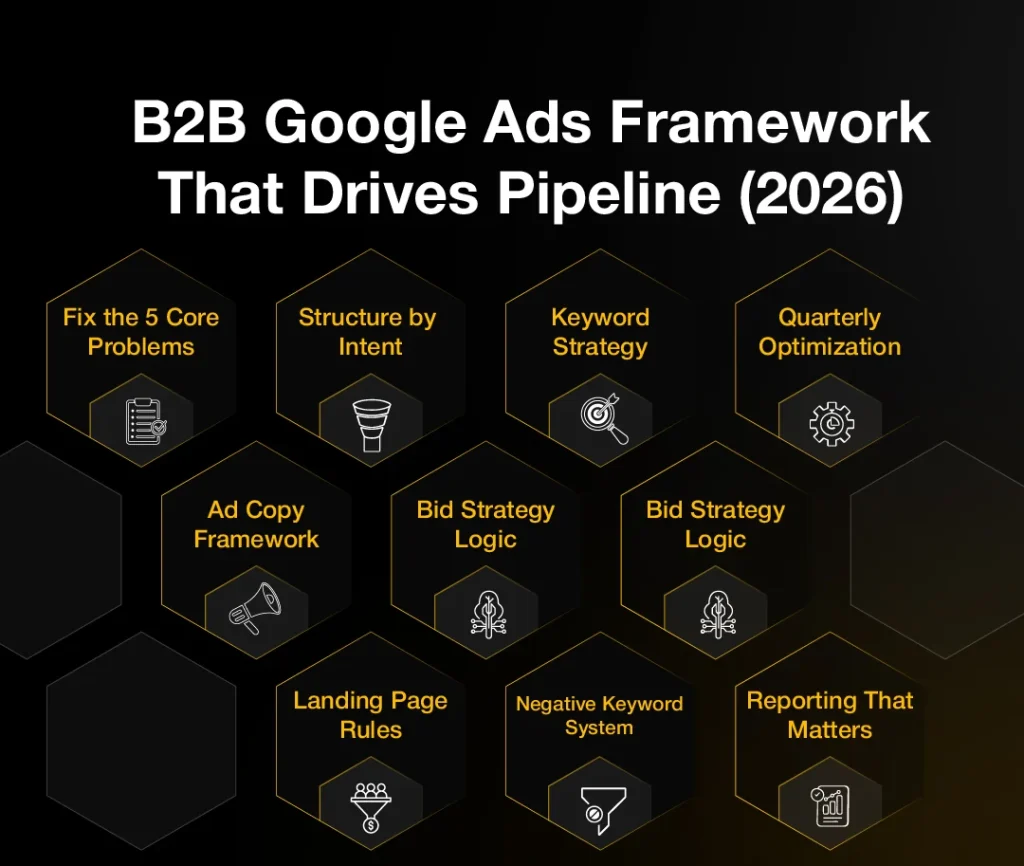
Bid strategies for B2B
Use Maximize Conversions or Target CPA only after you have at least 30 conversions per month per campaign. Below that, use Manual CPC or Enhanced CPC and let the data accumulate. Smart bidding without enough data optimises against noise.
For brand search, use Maximize Clicks or Target Impression Share — Target CPA is overkill for already-warm traffic. For competitor terms, start with manual bidding to control CPCs while you learn what converts; transition to Target CPA only once you have stable conversion volume.
When you switch bid strategies, expect 2-3 weeks of volatility while the algorithm relearns. Don’t panic and switch back during this period — that’s how teams trap themselves in permanent learning mode.
Ad copy that converts
B2B ad copy follows a simple framework: ICP-specific headline → outcome-driven sub-headline → social proof → CTA. Mention the buyer’s role or industry where possible (“For B2B SaaS marketing teams”). Use Dynamic Keyword Insertion only on tight ad groups, not as a lazy substitute for writing good ads.
Always include at least one ad with a number or specific claim (“Trusted by 400+ B2B teams,” “Reduce CPL by 30%”). Numeric headlines consistently lift CTR by 15-30% in B2B search.
Use all 15 headline slots and 4 description slots in Responsive Search Ads — Google needs the variety to test, and ad groups with full coverage outperform those with partial coverage by a wide margin.
Landing pages: match the ad, prove the outcome, ask once
Every landing page should match the ad’s promise (message-match), prove the outcome with social proof, and make a single ask. The most common B2B mistake is asking for a demo when the visitor is at “compare options” stage and would happily download a buyer’s guide first.
For high-intent keywords (“X software,” “buy X,” “X pricing”), demo request is appropriate. For mid-funnel keywords (“best X tool,” “X alternatives”), offer a content asset, comparison guide, or self-serve resource. Match offer to intent.
Landing pages should load in under 2.5 seconds, be mobile-first (B2B mobile traffic is now 40-50% on most accounts), and have one primary CTA above the fold. Test page variants continuously — landing page CR is the highest-leverage variable in any Google Ads program.
Match-type and ad-group structure
We default to a SKAG-lite structure for high-CPC keywords: 3-5 closely-related keywords per ad group, all in phrase and exact match. This produces tighter ad-to-keyword relevance, higher Quality Scores, and lower CPCs — typically 15-30% lower than broad ad-group structures.
For low-CPC keywords (under $3 CPC), grouping is less critical and you can use broader ad groups (10-20 keywords) without losing much performance.
Negative keyword discipline
Maintain three layers of negative keywords: account-level (universal junk), campaign-level (intent-mismatch), and ad-group-level (cross-group cannibalisation prevention). Review search-term reports weekly for the first two months, then bi-weekly.
A clean negative keyword list typically saves 15-25% of total spend. We’ve seen accounts where adding two months of disciplined negative work cut wasted spend by 40% with no decrease in lead volume.
Reporting: pipeline, not clicks
Report on pipeline created and CAC payback weekly. Report clicks and CPL only as diagnostic detail. The CMO question is always “what pipeline did we create from paid?” — your dashboard should answer that in one line.
Build a single executive view that shows: spend, leads, MQL conversion rate, opportunity conversion rate, pipeline created, and 90-day ROAS. Everything else lives one click deeper for diagnostics.
Quarterly review: what to inspect every 90 days
Every quarter, audit: keyword performance (cut bottom 20% by ROAS), landing page performance (test variants on top 5 pages), creative fatigue (refresh top-spending ads), bid strategy fit (re-evaluate based on conversion volume), negative keyword list (add 50-200 new negatives based on the last 90 days of search terms), and account structure (reorganise if any campaign is bleeding into others).
FAQs
